
The Cuban archipelago is located in the westernmost part of the insular Caribbean. Cuba has about 11 million inhabitants. Next to the island of Cuba there are more than 4 thousand islets and keys, being a territory of about 111 thousand km2. It has a landscape full of white sand beaches, complex and varied mountainous and hilly areas, with plains predominating among them. It is a fertile territory with numerous caves and natural reservoirs.
The idyllic paradise is complicated though as Cuba is suffering the largest exodus in its history due to the current situation they are going through. In addition to the economic and political crisis they are suffering, there are environmental problems such as soil degradation, high levels of pollution in human settlements, contamination of inland and marine waters, and a great loss of forests and biodiversity. All this situation is making it impossible for the inhabitants to develop their lives, and they are being forced to leave the Cuban paradise.
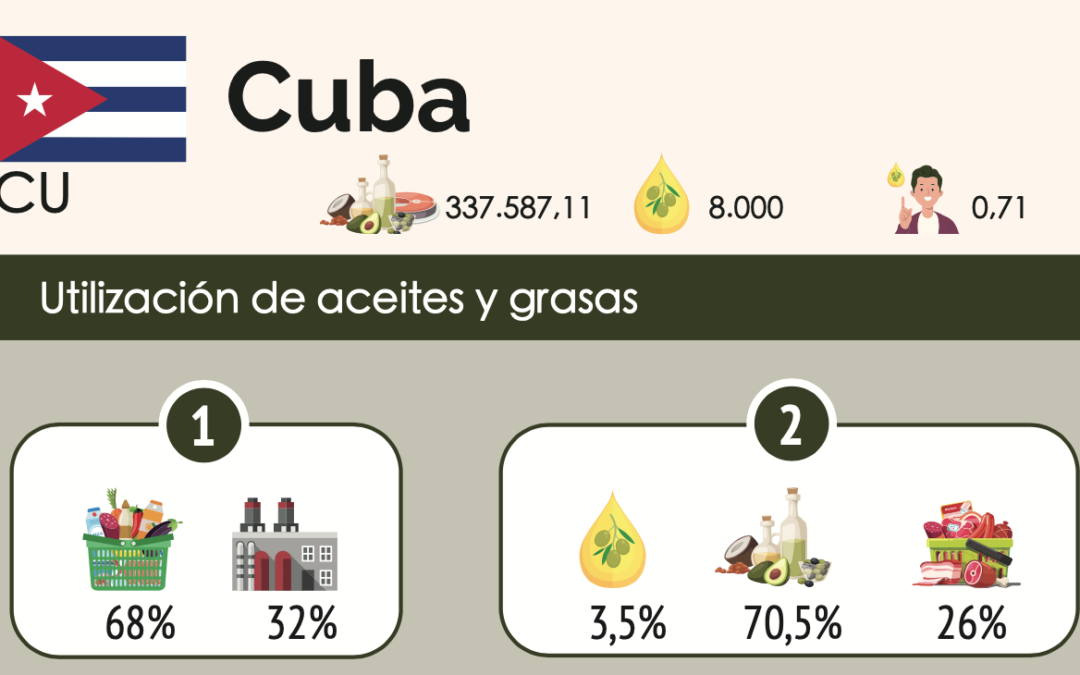
About 0.71 kg of olive oil is consumed per person. The total consumption of olive oil is 3.5% with respect to the other types of oils on the market in Cuba.
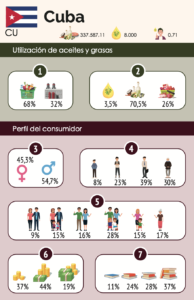
As for the consumption of olive oil according to sex, 45.3% is consumed by women and the remaining 54.7% by men. If we distinguish the consumption of olive oil according to age, the group between 50 and 65 years old predominates with 39%. As for the family structure, middle-aged families with children predominate, with a consumption of 28%, followed by singles or widowers with 17%.
With respect to purchasing power, those Cubans who have a medium-low income level (44%), have a higher consumption of olive oil than those who have a high income level (19%).
In terms of educational level, individuals with a higher level of education (university) have a higher consumption of olive oil (37%). However, those with no education, their consumption amounts to no more than 11%. In general, olive oil continues to be unknown to the lower-middle consumer, although its qualities are appreciated by more educated consumers.
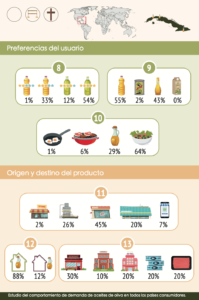
Of the different varieties of olive oil, the most predominant is extra virgin olive oil with 54%, followed by olive oil with 33%. Virtually none of the olive pomace oil is consumed (1%).
According to the type of packaging, consumption is higher in PET packaging with 55% and glass packaging with 43%, with 2% in cans and no other types of packaging being used. The main use of olive oil is raw, i.e. for seasoning (64%), although the use of olive oil for cooking (29%) also stands out to a lesser extent than the previous one.
The main establishments where the inhabitants of Cuba buy olive oil are supermarkets (45%), followed by other establishments such as oil mills, bottling plants, bars and other points of sale (26%).
The majority of users in this country consume olive oil in their own homes (88%), only 12% do so outside their domestic environment. Outside the home, the establishments where olive oil is most consumed are bars and restaurants (30%), equaling 20% in industry and canneries, hotels and food processing industry, reducing to 10% in collectivities.
Until now, olive oil has been a less accessible product in this country due to its price, but it is also true that in less than a decade there has been a positive evolution in relation to the consumption and purchase of olive oil in Cuba.