
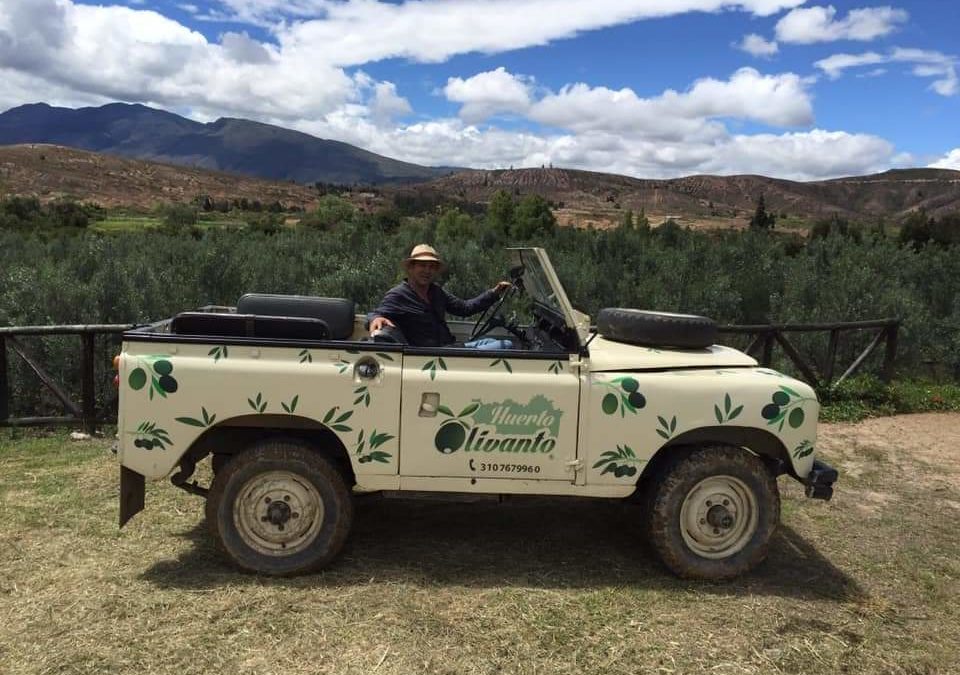
José Gabriel Aranzazu Hernandez, the Director of Frutalia, a Colombian company dedicated to the elaboration, industrialization and selling of fruit products, gives us an overview of the olive growing in that country. In a small farm near Villa de Leyva, Boyacá department, called «Huerto Olivanto», they are currently working on a family enterprise of 3 hectares with 1250 olive trees which were planted in 2008 (on the Sáchica-Sutamarchán road), Alto Ricaute region.
Colombia, located in the middle of the tropical zone of the American continent, has a rich olive growing history that begins with the arrival of Europeans at the beginning of the 17th century. Since 1608, Villa de Leyva has been linked to cultivation. At this time, missionaries founded a convent in the vicinity of that town and planted the very first olive trees. Later, events associated with the history of the country and the continent led to an increase of cultivation in the area, and then led to its disappearance at the end of the 18th century.
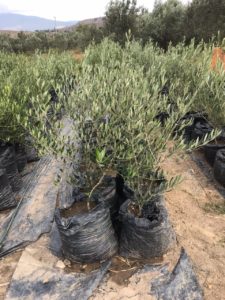
At the end of the XIX century and in the middle of the XX century, due to governmental incentives, cultivation was resumed in the region by Villa de Leyva, and the localities of Sáchica and Sutamarchán located at 5o 4′ longitude North in the middle of the tropical region and in a microclimate composed by a height of 2,200 meters above sea level, 980 mm of annual rainfall, a relative humidity of 45% and an average minimum temperatures of 7o and maximum 26o. Currently, three major varieties can be found here, which were(Arbequina, Picual and Pajarera) grafted onto wild olive trees. Another 30 European varieties, some ecotypes adapted from Mexico, the United States, Chile, Peru and local (Vileyva) that have survived since the introduction of the crop to the present are being evaluated and vegetatively propagated to be sold.
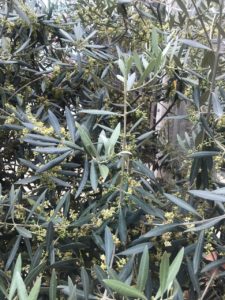
The tropical climate conditions force us to learn constantly, as it is a unique environment in the world. For example, the inclination of the light affects the trees’ height throughout the year, therefore the trees grow upwards rather than growing laterally. In addition, there ar 3 or 4 cycles of flowering, which is a potential productive advantage. In the region there are trees that have produced up to 100 kg of olives.
In the 50 hectares that are cultivated in Colombia, poor soils (expansive clays, little or no organic matter), high amounts of erosion, and climatic instabilities (lack of cold in winter and of water in summer) have been the biggest complications that we have had to face in the family enterprise, in which led to a production that was nearly null in the last campaign when on average 10 tons were obtained.
Irrigation has had to be used to deal with the water deficit between low rainfall in the area and high relative humidity. Obtaining water has become another difficulty to overcome, with few sources available. Only a few lagoons that accumulate during the winter have water that is suitable for cultivation to withstand the summer, which is almost 4 months between December and March until the return of rainfall between April and July.
Olive growing in Colombia is very precarious, due to the low extension of cultivation, reduced productivity and the fact that most of the trees are old, survivors of abandoned crops or destined for tourist farms. Our project of olive trees is a secondary activity in the productive processes that we develop, and it is maintained fundamentally by the passion of its founder, Antonio Cortés Robles, who after a long professional trajectory, at his 91 years of age has chosen the olive grove as a legacy for his grandchildren which motivates us to work.
The perspective of olive growing in the country depends to a great extent on the governmental promotion, which must look and be interested in knowing that in the area there is a great potential of development for this crop, since there are 45 thousand hectares available. If this is not done, the future of olive growing development is very uncertain, since irrigation infrastructure works must be developed in order to survive and grow this crop. Otherwise, they will have to be individuals who are passionate about the subject and who want to invest in a promising crop that has a free future in the Colombian market. The average consumption of 100ml/person/year, is supplied entirely by imports of 5 thousand tons mostly from Spain, of the varieties Arbequina, Picual and Koroneiki. The sales price varies between 4 and 12 Euros, depending on the quality.
How to cultivate olive trees in Colombia. https://youtu.be/FhtA0QJpPdU