

Tomiko Tanaka graduated in Marketing and was working in Japan until she decided to make a radical change in her life. She decided to go the Andalusian capital of Seville. She arrived to learn Spanish, but soon found a great passion in Andalusia: olive oil. Today she is an expert taster of this product. In 2006 she set up CREAPASION, a website and business. She did this after finishing the Olive Oil Tasting Expert course at the University of Jaen.
During this time she expanded her knowledge through the acquisition and absorption of the tasting experiences, producers and consumers, in addition to the cultivation (Higher Course of Olive Culture, IFAPA, Córdoba). Today it is reknown in sensory analysis, qualification and overall qualification of extra virgin olive oils through the application of best practices of cultivation, harvesting, and production. CREAPASION collaborates with producers to develop products that can satisfy the demands of international buyers who require certain specifications, organoleptic aspects, or compositions, that are attractive to cooks, consumers, and clients in Japan. It gives us an overview of the olive growing activity, consumption and characteristics of the public in that market of this incredible product.
Olive growing in Japan dates back more than 110 years ago. At the beginning of the 20th century, the Ministry of Agriculture and Trade planted olive trees in 3 prefectures: Mie and Kagawa (on Shodo Island) and Kagoshima to supply oil for the fish canning industry. The only place where they grew was in Kagawa Prefecture, where olive groves and history are concentrated today, and the cultivated area is 150 hectares. About 20 varieties were planted there and 70% of the olive trees are of the Mission variety, brought from the United States. This island leads the cultivation and elaboration of EVOO in Japan. In fact, it is home to the «Shozu Olive Research Institute» where research is carried out on the cultivation and the olive oil, as well as having a tasting panel recognized by the International Olive Council. Two new varieties have been developed: Ka-Oli No.3 and Ka-Oli No.5 that olive growers will start to cultivate from March 2021.
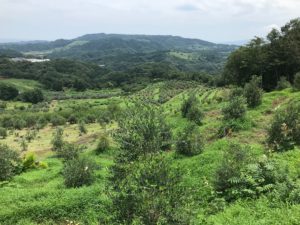
The cultivation is expanding in the country towards the north, to the city of Iwaki (37º02’00 «N140º53’00 «E) with an average temperature of 13.3º and average annual precipitation of 1369 mm. There are also olive groves near Tokyo.
The most important olive grove is in the prefecture of Kanagawa, owned by the company «Farm Village Shonan Co.,Inc» https://www.farmvil-shonan.co.jp/ of the conglomerate Shonan Landscape Co., Ltd. It was founded 98 years ago and started by gardening flowers, especially roses, and now dedicates itself to architecture and landscaping. The current president Mr. Kiyoshi Makabe is the third generation in the management of the company. «Farm Village Shonan Co., Inc. was founded in 2015 as a subsidiary to promote olive growing, encouraged by regional promotional measures. They owned a large amount of land, and in order to make effective use of it, as the olive tree was very popular in Japan, they started cultivation for ornamental use in gardening. In addition, the risk of initial investment was low. Associated with the promotion of its healthy qualities, interest in Japanese society increased and olive oil sales thus began to rise.
The area where olive trees are grown is a warm bay front area with a wealth of marine products. The business objective is that the oil is in harmony with the local products and the coastal town.
Consumption is increasing in line with the awareness of developing a healthy life, and mostly the young generations have accepted it with great pleasure. Compared to producing countries in other continents, the cultivated area is relatively very small and the activity is not competitive, however, due to the long-term regional development and revitalization of agriculture, which is of social interest in Japan, the olive tree is considered to be a very suitable crop, even if it needs time to develop. There are many abandoned lands in this area which, because of their suitability, can be used for olive growing to counteract this situation. Lately the number of olive growers has increased, who wish to associate and expand, developing and valuing their brands and the consumption of olive oil, participating in exhibitions spreading their local products, the oil, as well as oil tourism.
Given the small size of the activity at national level, it is vital to the organization of producers to help them solve plant health problems, pest control, crop management and counteract inclement weather such as typhoons, in addition to professional training.
The largest cultivated area is on Shodo Island, 5.5 hectares at 202 meters above sea level, with a 5 x 5 plantation framework, in dry land and 13 varieties. The most common varieties are Mission, Arbequina, Picual and Koroneini. In 2019, 2 tons of olives and 110 liters of oil were produced. Diseases and pests are typical of the humid and rainy climate (soapy olive, repilo, fumagina, weevil and olive moth).
The J-OIL MILLS,INC conglomerate located in Tsurumi-ku, Yokohama City, Kanagawa Prefecture, dedicates itself to the import of olive oils with a market share of more than 20%. The companies that make up the company have consolidated their position, contributing their own know-how in the vegetable oil segment, offering safe and protected food products that satisfy the diverse needs of their clients. In recent years, they have planted a small area of dry land (half a hectare), 100 olive trees of 21 varieties, both in terms of cultivation and oil composition, on an experimental basis: Picual (30), Lucca (20), Koroneiki (20), Lecchino (3), Coratina (3), Correggiola(2), St. John’s (3) and St. George’s (3). Catherin (2), Moraiolo (2), Rosciola (2), Misión (2), Hojiblanca (2), Nevadillo Blanco (2), Arbequina (2), Barnea (1), Barouni (1), Jumbo Kalamata (1), Hardy’s Mammoth (1), I-77 (1), Areccuzzo (1), South Australian Verdale (1) and California Queen (1). They currently produce 200 kg of oil, hoping to reach 3 tons in five years. Its objective is to contribute to the development of the crop, taking into account its experience in sensory evaluation and physicochemical analysis, the technology of storage and bottling, and a broad sales network. In addition, through cultivation and research, they have proposed to improve the quality of the product in Japan, and to make effective use of the oil mill in the cultivation area in order to promote regional revitalization. The oil obtained so far is complex, delicate and smooth, with fruity notes and light bitter and spicy, which they hope will be accepted by the public and combine well with the Japanese diet Washoku.
Thirty years ago the annual consumption per capita was 3 grams, and is currently 600 grams. This increase was originated by the promotion of the product, to which initially nobody knew anything about, however, by the presence of the olive oil very frequently in programs of kitchen in television, among other factors, it has imposed its use in many types of non-Mediterranean dishes. The promoters of the product claim that the olive tree and olive oil are a part of Japanese culture like soy sauce, miso (fermented soy) or sake. In addition, olive growing and ancestral history have fascinated the population and the consumer. Looking at the country in general, there is still much to be transmitted. The consumption in Japan depends mainly on the imports that amounted to 70 thousand tons last year, and the activity is not known neither to those who develop them, or to those who are looking to revert this situation to further expand olive oil culture in the future.