
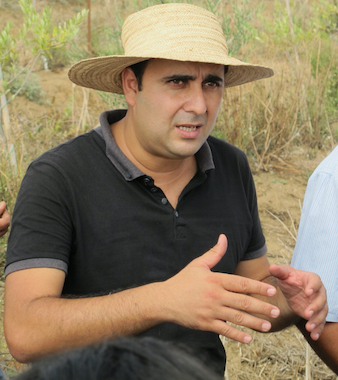
Dr. AJMI LARBI, an Agricultural Engineer in plant production. I began my professional work as a researcher at the Olive Institute in Tunisia in 2003. Currently, I am the head of the department of integrated olive production in the North of Tunisia.I have been a national consultant for FAO in Tunisia (2016-2020) for the training of technicians and farmers in olive growing. I am also a member of several national commissions for the development of olive growing in Tunisia.
The scientific activities developed since my integration in the Olive Institute are focused on the study of production systems such as the super high-density system and the high density system from the varietal behavior to the pruning techniques in these systems. Salinity and fertilization optimization are also part of the activities carried out. The development of the concept of integrated production is also one of the activities being developed by the research team to which I belong.
I am the author and co-author of 30 scientific publications, book chapters (4) and technical notes (4). I have participated in 40 congresses and seminars. I have been a collaborating researcher in more than 12 research projects. My research team and I were true pioneers in the world as we published results related to the super-intensive system in Tunisia (3 publications) in scientific journals with impact index.
What is the olive sector’s current role in Tunisia?
The olive oil sector is a strategic sector in the national economy of Tunisia because of its high contribution to the economic output of the country (foreign exchange earnings), to the foreign exchange earnings, for the employment it generates (50 million working days per year) and for its environmental role. It has an area of 1.95 million hectares of olive groves with almost 90 million trees. A large part of this area is cultivated under rainfed regimes, which affects productivity substantially as it is considered to be the lowest in the Mediterranean. In fact, olive oil production during the last decade varied between 120,000 tons and 350,000 tons with an average of almost 180,000 tons of olive oil. To alleviate the variability of production from one year to another, a strategic plan was launched in 2001. It was launched in order to increase the irrigated olive grove area. Today there are some 100,000 ha (4.5% of the total area) that are irrigated. Despite the wealth of genetic resources, two varieties dominate the Tunisian olive grove. There is chemlali, which is grown mainly in the center and south of the country (arid and semi-arid regions). Then, there is chetoui,which is grown in the north of the country. Olive oil is Tunisia’s most important agricultural product, accounting for 50-60% of the country’s agri-food exports and over a million people depend on the sector. In fact, olive oil exports contribute almost 2-3% to the national economy reaching 7% in some years as was the case in 2005. In spite of the importance that the olive oil sector holds in Tunisia’s national economy, some difficulties are limiting the growth of the sector and its future potential. In fact, today the olive sector is characterized by a large number of operators: around 309,000 farmers, more than 1,700 oil mills, 50 packaging companies and a large number of exporters who generally act on an individual basis. In addition to this large number of operators, there are a number of public development and monitoring structures that derive from the Ministries of Agriculture: Agriculture, Ministry of the Environment, Ministry of Industry and Ministry of Trade. However, the sector is characterized by a lack of horizontal and vertical integration of the various actors, as well as a lack of coordination of the various state development agencies and this is especially noticeable at the production level where there is an absence of cooperatives or other structures that would bring farmers together.
What is consumer behavior like in Tunisia?
With respect to the olive oil consumption in Tunisia, it is estimated that the quantities consumed amount to 37,200 tons per year and that during the last years (except 2020), a decrease of consumption of almost 2% per year has been registered due to the increase of prices. At present, a plan is being implemented to make consumers aware of the importance of consuming extra virgin olive oil. The campaign is meant to give consumers greater awareness of the close relationship between diet and health, which will lead them to consume more natural products with beneficial effects on health.
Where is it purchased? By whom, and in what format?
Olive oil in Tunisia is marketed in two circuits. The main one is the traditional circuit (short circuit) where the oil is bought directly in the oil mills and whose format is gallons of 10 and 20 litres. Usually, the necessary quantity is bought for the whole year and that quantity can vary according to the oil prices. These traditional purchases are very common in the Tunisian oil-producing regions such as Sfax, Sousse, Mahdia and Monastir. The second is the long circuit where oil is bought in different formats such as plastic (PET), glass or gallons of 3 and 5 liters. It should be noted that the lack of knowledge about the quality of the product and its health benefits is the main disadvantage in the development of its market and limits the possibility of using quality signs. Moreover, according to studies of Tunisian consumers in the capital, it is known that taste and price are the main determinants when purchasing olive oil. Then there is the type, the packaging of the product and the variety of the olives.
How could olive oil consumption increase in Tunisia?
Although Tunisia is considered to be an essential olive oil exporting country where exports are almost 140,000 tons on average, work is being done at different levels to boost and increase the national consumption of olive oil in order to give more stability to this sector. In fact, lately Tunisian olive oil producers are focusing more on quality rather than price competitiveness and increasingly Tunisian bottled oils are being recognised at international level and have won prizes in prestigious competitions such as the Los Angeles, New York, Bioliva and Japan competitions, although there is still a need for Tunisian oils to be recognised for their quality in all market segments. This will make bottled olive oil more recognized by the Tunisian consumer, since these awards are very well publicized by the media.