
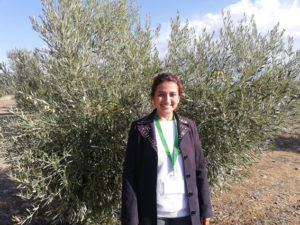
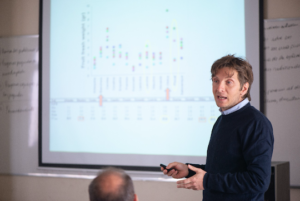
My name is Mariela Torres and together with Pierluigi Pierantozzi, I am a curator of the Olive Tree Collectionbelonging to our National Institute of Agricultural Technology – EEA San Juan – Campo Anexo San Martín in Argentina.
Before starting to tell you the history of our collection, we would like to clarify some concerns such as, ‘What is a germplasm bank?’ and, ‘Why is it important to preserve a germplasm bank?’
In the first place, germplasm banks are conservation sites of biological material par excellence, whose purpose is the conservation of biodiversity. They are key sites to prevent the loss of genetic diversity under pressure from various factors such as environmental, physical and biological factors and human activities.
The ex situ conservation, understood as the maintenance of the germplasm organisms outside their natural habitat, arises as a complementary measure to the in situ conservation mechanisms, and seeks to safeguard the genetic resources fundamentally through storage and propagation operations of germplasm collections representative of the variability that is to be preserved. One of the forms of storage is carried out through the maintenance of field collections. This is the case of our Institutional Olive Tree Collection.
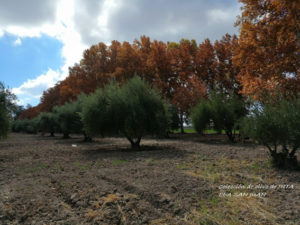
INTA–EEA San Juan Olive Tree Collection
Our collection has three nuclei of different ages, genetics and typology, which house hundreds of representative olive tree cultivars for the sector (oil and table olives). The original nucleus, which we will call from here on, Collection of Olive Tree ‘Dante Floreal Marsico’ was created by the National Corporation of Olive culture at the end of the decade of ’40. It was part of the National Network of Experimental Tests of Varieties and its main objective was to carry out experimental and research tasks aimed at analyzing the ecological and economic suitability of the different olive-growing areas in order to determine the extension or limitation of the cultivation area at a national level. Currently, the ‘Dante Floreal Marsico’ Olive Tree Collection consists of 6 ha. These olive trees have been implanted in our province for almost a century, constituting a true legacy for San Juan, since the link achieved between these ancestral olive trees and the territory is extremely close.
On the other hand, in 2015, the expansion of the institutional germplasm bank (Núcleo ‘INTA Expone’) was started, introducing new varieties not present in the ‘Dante Floreal Marsico’ Olive Tree Collection in an area of 0.5 ha. In 2019, work continued on the extension of a plot adjacent to the ‘Dante Floreal Marsico’ Olive Tree Collection, covering a final surface area of 8 hectares.
In 2019, our collection was declared a Cultural and Natural Heritage Site of the province of San Juan, and currently represents the largest olive tree collection in America.
In this way, the interest of our Institution in continuing revaluing the olive genetic resources is reflected, thus avoiding the genetic erosion of the crop. In this sense, it is important to highlight that there are approximately 2000 olive tree cultivars worldwide. However, at a commercial level only a few dozen such cultivars are cultivated. In this way, both the technical and the productive sectors need to start revaluing this olive-growing heritage and reflect on various aspects of the crop: adaptability to new regions, distinctive management and use of various resources (water, nitrogen, etc.), differentiated production and marketing of olive oil and table olives, among other aspects.
Within the activities that we develop with our work group, characterization, identification and evaluation tasks are carried out by means of morphological, agronomic, biochemical, molecular and technological descriptors. In this sense, we evaluate different descriptive characteristics of the tree and different organs of the tree (leaf, fruit, endocarp, inflorescence, flower). We have also implemented the creation of an endocarp and DNA bank for the exchange between the network of world olive collections (International Olive Council Network, IOOC).
Thus, throughout these years, INTA San Juan has managed to generate enough knowledge of these olive cultivars, which is reflected in the numerous publications in national and international journals, as well as in the extension activities provided to the olive sector.
It is worth mentioning that this work counts on the active participation of the productive sector (local and national), as well as the academic sector (IMBIV-UNC-CONICET, CNR-IBBR, CNR-ISAFOM, UCO, IFAPA, among others).
As mentioned above, the main function of a germplasm bank is the conservation of genetic resources. In this sense, it is worth mentioning that there are three world banks of olive germplasm recognized by the IOOC, which are located in the main historical production nuclei worldwide (Spain, Turkey and Morocco). Precisely, our Germplasm Bank is the reference for Argentina before this Council.
In this way, the conservation of our Olive Germplasm Bank is not only of provincial and national importance, but also of world importance, since it represents a true source of genetic variability in the cultivation of olive trees for the future benefit of humanity and the environment. It is important to emphasize that all genetic resources for food and agriculture constitute the biological basis of world food security and contribute to the livelihood of all people on Earth. In this sense, the EEA San Juan – INTA Germplasm Bank also represents the indispensable raw material for the genetic improvement of the olive tree developed by our Institution, being also essential for the adaptation to the unpredictable changes of the environment and human needs.
Mariela Torres and Pierluigi Pierantozzi are researchers at the National Institute of Agricultural Technology (INTA – EEA San Juan) and the National Council of Scientific and Technical Research (CONICET – CCT San Juan) in Argentina.
Contact us: torres.mariela@inta.gob.ar; pierantozzi.pierluig@inta.gob.ar