
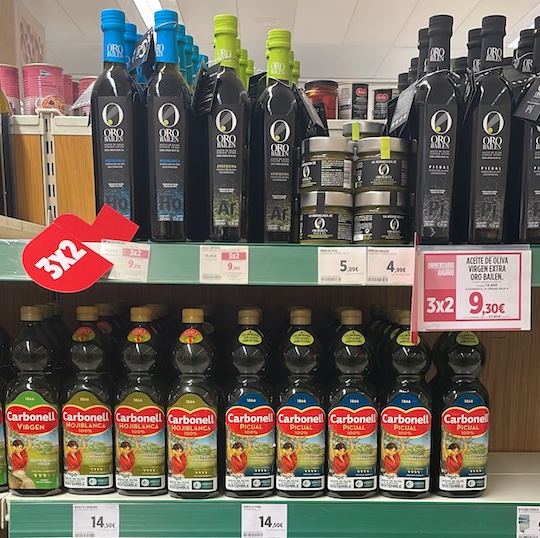
This is one of the conclusions drawn from the study presented within the Master’s Degree in Olive Oil Business Administration of the University of Jaén through its Observatory of Consumption, the analysis has been conducted by Juan Carlos Marín, head of grocery at Alcampo, and guest lecturer of this postgraduate course, Carmen Morillo financial director of Grupo Oleícola Jaén, and also guest lecturer of the aforementioned master, and Juan Vilar, co-director of the same program, and international olive oil analyst. The three are members of the university classroom Oleícola Innova, also involved in this study, an initiative of the International University of Andalusia, Antonio Machado headquarters, and the Grupo Oleícola Jaén.
In the study, which was carried out between January and September of this year, both inclusive, taking into account all types of oils and fats consumed in Spain in supermarkets and hypermarkets, 63 hypermarkets and almost 250 supermarkets have been analyzed, having an incidence in households represented that exceeds one million, which is equivalent to just under 2, 6 million consumers, hyper- and supermarkets represent a market share for the category of 68 percent of demand, so the sample has a high degree of representativeness, representing almost 5 percent of the total sales volume of olive oils sold in the country, in supermarkets and hypermarkets, and the same percentage if we talk about sales area.
The study shows that in the first nine months of the year there has been an average drop in demand for refined olive oil of 10.2 percent, with the drop being greater in the larger volume containers, such as the 5-liter PET bottle, which has fallen by 24.68 percent, The drop was also twice as large in the case of mild oil as in intense oil, minus 18 versus minus 9 percent, while pomace oil increased its demand by more than 86 percent for the period studied, with joint prices rising by an average of 40.38 percent, with the largest volume containers rising more.
In the case of sunflower oil, demand grew by 21.20 percent, while prices rose by 31.12 percent.
In the area of virgin oils, demand increased by 2.14 percent, with the demand for virgin, non-extra virgin oils rising by 68.46 percent, while extra virgin oils with larger volumes fell by more than 10.6 percent. The average accumulated price increase is 31.12 percent.
So there has been a transformation in consumer preferences for olive oils, turning to virgin, instead of extra virgin, and also towards pomace oils, and especially small formats, which is segmenting the purchase more, dosing its use, buying more online, and although their loyalty is firm, begins to yield in demand in favor of other olive oils, as is the case of pomace and mainly sunflower outside the olive.
If we refer to macro data, and all this from figures elaborated in our own way from MAPA information. (MINISTERIO DE AGRICULTURA, PESCA Y ALIMENTACION, Dirección General de Producciones y Mercados Agrario Subdirección General de Cultivos Herbáceos e Industriales y Aceite de Oliva), if we analyze the internal consumption (households, catering and food industry) for the months between January and September, both included, there is a fall in the accumulated consumption of almost 200 thousand tons, or what is the same, If we refer in the same terms to exports, these fall 320.4 tons, that is, 38.73 percent, however, imports grew by 10.10 percent, however in 2022 these accounted for 8.7 percent of the total production of the country, and this year, for the same period analyzed, they would account for just over 21 percent.