Argentina is one of the main producing countries in South America. In addition to being a producer, it is also a consumer. It accounts for 1% of world production. The harvest season begins towards the end of January in the province of Córdoba and lasts until mid-May, starting with the canned varieties and continuing with the oil varieties.
It is ranked 13th among countries with the largest crop area, as well as 11th in olive oil production. 69.6% of the production is dedicated to olive olive while 39.4% is for table olives.
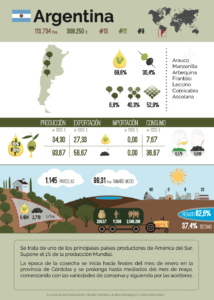
Among its crops, super-intensive and intensive crops stand out, and traditional crops are less present. Traditional crops account for 6.8%, followed by intensive crops (40.3%) and super-intensive crops (52.9%). With respect to the water regime, irrigated crops lead with 62.3%.
This country produces 43.300 tons of olive oil, 65% of which is of superior quality (virgin or extra virgin) and 35% of which is of lesser quality, such as lampante. Of the total olive oil production, 27,330 tons are exported to other countries. As for table olive production, 93670 tons are produced, of which 56,670 tons are exported to other countries.
It has 1,145 plots, with an average size of 99.31 hectares. Each plot produces 0.434 tons of olive oil and 2.710 tons of table olives.
At present, this country has 60 olive mills and 20 bottling plants. The turnover generated by the olive sector in Argentina is 220.57 million euros. Also, it generated 2,585,206 annual working days in the olive sector and related industries.
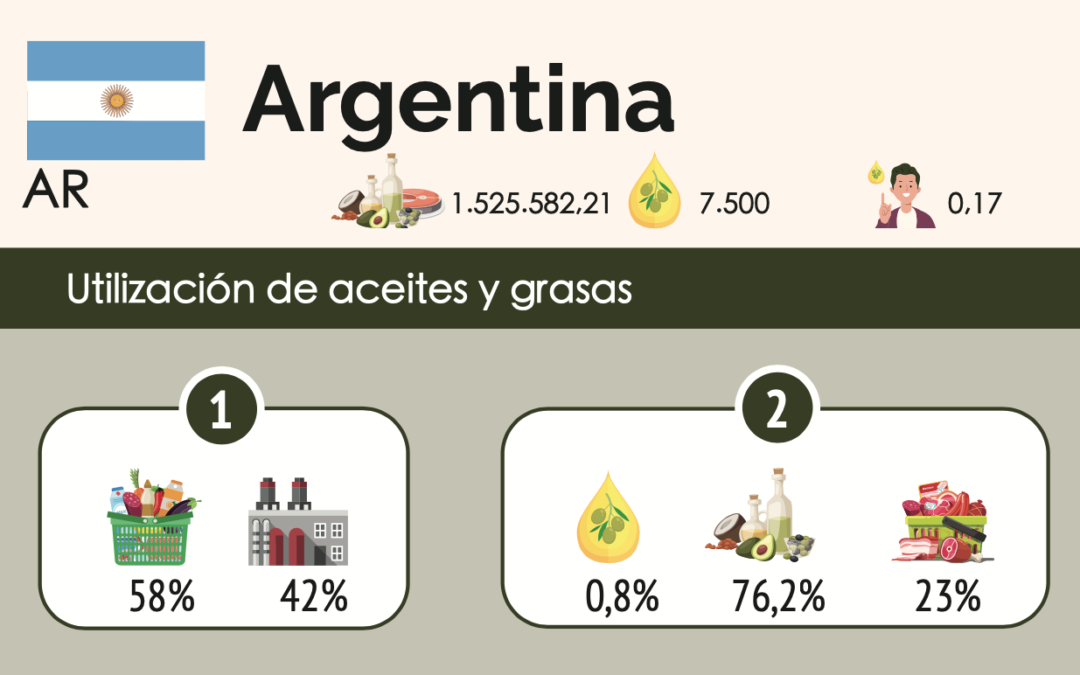
In addition to Argentina being a producing country, it is a consuming country. It consumes 0.17 liters of olive oil per capita per year, which represents 0.8% of the total of animal and vegetable fats.
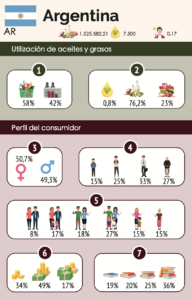
With respect to the profile of the Argentine consumer, women (50.7%) consume it slightly more than men (29.3%). According to the age range, it is consumed in a higher proportion by people between 50 and 65 years of age (33%), followed by those over 65 years of age (27%). (33%), followed by those over 65 years of age (27%). Consumption is lower in people under 34 years of age.
With respect to family structure, the highest consumption of olive oil is in middle-aged families with children (27%), followed by middle-aged families without children (18%). The lowest consumption with respect to family structure is in young families without children (8%).
According to the level of income, the Argentine inhabitants who have an average income are those who consume olive oil in a more notorious way (49%). In addition to the income level, according to the academic formation, more olive oil is consumed in those individuals who have university education (36%), where the consumption is lower is in those people who do not have academic formation (19%).
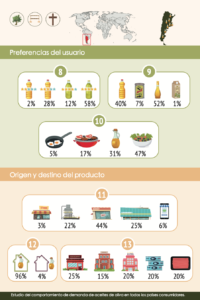
Different types of olive oil can be found in the market. In this country in particular, the highest consumption is of extra virgin olive oil (58%), followed by olive oil (28%). The packaging in which olive oil is consumed is glass (52%), followed by PET containers (40%).
According to the intended use of olive oil, it is mainly used crudely, for salad seasoning (47%), followed by being used for cooking (31%). Where olive oil is least used in cooking is for frying food (5%).
According to the type of establishments where olive oil is purchased, olive mills, bottling plants or bars predominate in the first place with 44%, followed by hypermarkets with 25%. This product is least sold in traditional stores, accounting for 3%.
The majority of Argentine individuals consume olive oil in their homes (96%), and 4% do so outside their homes. Of this 4%, the establishments where they consume it can be in bars and restaurants (25%), hotels (20%) or the canning industry (20%).